
CSR Implementation Agency in India: How to Select the Right NGO Partner
Corporate Social Responsibility (CSR) in India has gradually moved beyond cheque distribution and one-day community activities. Companies are increasingly looking for organisations that can take responsibility for implementing projects on the ground, manage local partnerships, engage communities and demonstrate what has actually changed as a result of their investment.
This makes the choice of a CSR implementation agency particularly important.
A well-designed CSR project can lose its effectiveness if the implementing organisation lacks field experience, local knowledge or the ability to monitor activities over time. Similarly, an organisation with a good reputation may not necessarily have the operational capacity to execute a large or technically demanding project.
For companies planning environmental, educational, healthcare or community development initiatives, selecting the right NGO partner requires more than checking registration documents. It involves understanding how the organisation works, what it has delivered and whether it can manage the project throughout its lifecycle.
This guide explains what companies should look for when selecting a CSR implementation agency in India, particularly for environmental and sustainability projects.
What Is a CSR Implementation Agency?
A CSR implementation agency is an eligible organisation that carries out Corporate Social Responsibility projects on behalf of a company.
Under Section 135 of the Companies Act, 2013, companies meeting the prescribed financial thresholds are required to spend at least 2% of their average net profits of the preceding three financial years on CSR activities, subject to applicable provisions.
Companies can implement CSR projects themselves or work through eligible implementing agencies, including qualifying registered public trusts, registered societies and Section 8 companies.
An NGO working as a CSR implementation partner may be responsible for:
Identifying suitable project locations and beneficiaries.
Preparing project proposals, budgets and implementation plans.
Obtaining relevant permissions and coordinating with local authorities.
Mobilising communities and technical teams.
Procuring materials and managing field activities.
Monitoring project progress and maintaining documentation.
Measuring outcomes and preparing utilisation and impact reports.
The role is not limited to executing the activities mentioned in a proposal. A dependable implementation partner should be able to manage the practical challenges that arise during the project.
Why Choosing the Right NGO Partner Matters
A CSR project often involves multiple stakeholders, including the funding company, implementing organisation, local government departments, beneficiaries, technical experts and community representatives.
Each stakeholder has different responsibilities and expectations.
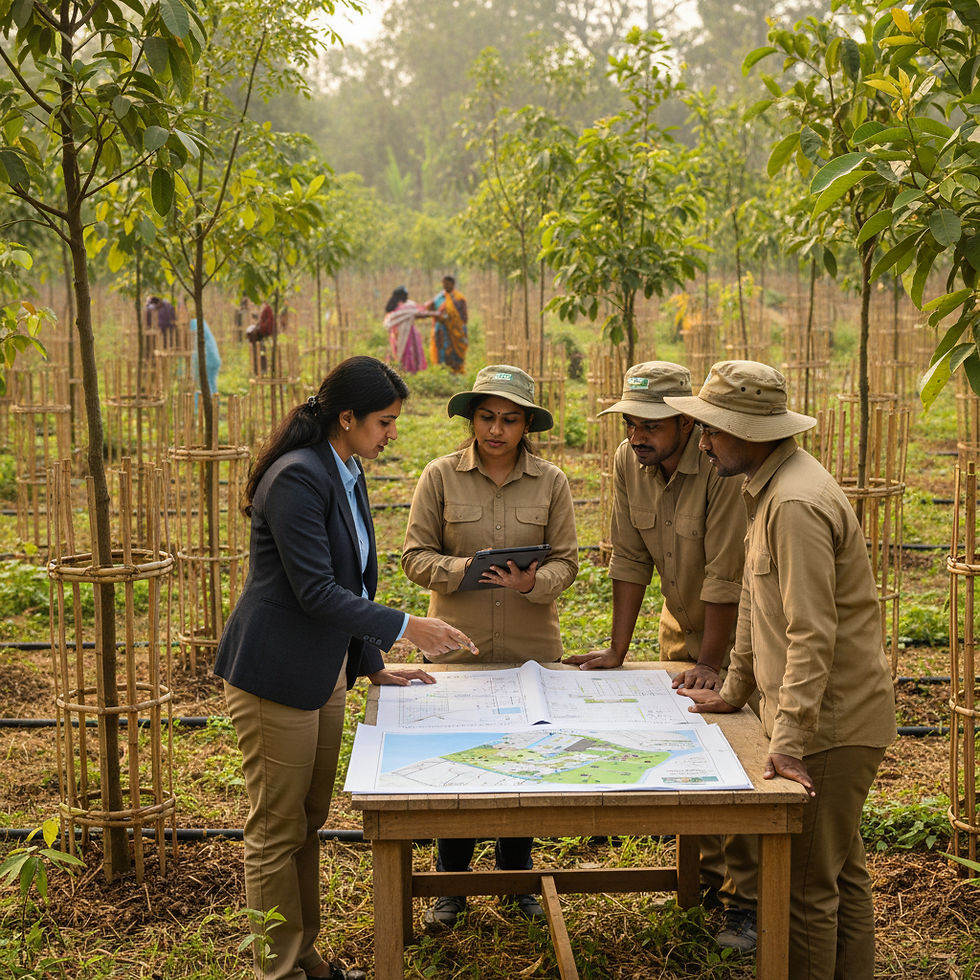
For example, a corporate tree plantation programme may appear straightforward at the planning stage. However, successful implementation requires suitable land, permission from the concerned authority or landowner, appropriate native species, seasonal planning, maintenance arrangements and monitoring of tree survival.
Without these arrangements, the project may achieve its plantation target but fail to deliver meaningful ecological benefits.
The same applies to water conservation, waste management, biodiversity restoration and rural livelihood initiatives.
The right NGO partner helps a company move from an approved CSR budget to a properly implemented project with measurable results.
10 Things Companies Should Check Before Selecting a CSR Implementation Agency in India
1. Verify the NGO's Legal Registration and CSR Eligibility
The first step is to establish whether the organisation is legally eligible to undertake the proposed CSR project.
Companies should verify:
Registration certificate of the trust, society or Section 8 company.
PAN and organisational registration details.
12A registration, wherever applicable.
80G approval, wherever applicable.
CSR-1 registration and CSR Registration Number.
Applicable FCRA registration or prior permission if foreign contribution is involved.
Audited financial statements and annual reports.
Under the CSR Rules, eligible implementing agencies generally need to meet the applicable registration and track-record requirements. CSR-1 registration is an important compliance requirement for eligible implementing agencies.
Companies should also verify whether the organisation satisfies the specific eligibility conditions under the Companies (CSR Policy) Rules, 2014, as amended.
Having CSR-1 registration alone does not automatically establish that an NGO has the operational capacity or relevant experience to implement every type of project.
2. Examine Actual Project Experience
An organisation may have a broad list of activities on its website, but companies should look beyond programme descriptions.
Ask for details of completed and ongoing projects.
For environmental CSR initiatives, relevant experience may include:
Native tree plantation and forest restoration.
Urban forest development.
Biodiversity conservation.
Lake and waterbody restoration.
Rainwater harvesting and groundwater recharge.
Waste management and resource recovery.
Sustainable agriculture and agroforestry.
Community-based environmental programmes.
Request project photographs, implementation reports, locations, budgets, completion records and references wherever available.
A particularly useful question is whether the NGO has managed projects similar in scale and complexity to the proposed assignment.
3. Evaluate Field Presence and Implementation Capacity
An NGO may have its registered office in one city while implementing projects across several states.
This is not necessarily a problem, but companies should understand how field operations will be managed.
Ask the organisation:
Does it have an established field team?
Does it work with local implementation partners?
How frequently are project locations visited?
Who supervises on-ground activities?
How are delays and implementation challenges addressed?
Does it have the technical expertise required for the project?
For projects involving land restoration, water management or biodiversity, local knowledge can make a considerable difference.
An implementing organisation should understand the site, local conditions, permissions and the people who will be directly affected by the intervention.
4. Assess the Quality of Project Planning
A good CSR proposal should explain exactly what will happen after the project receives approval.
Companies should expect a clear project plan covering:
Project objectives and intended outcomes.
Geographical location and target beneficiaries.
Proposed interventions and implementation methodology.
Project duration and milestones.
Human resources and technical requirements.
Permissions and statutory approvals.
Budget allocation.
Maintenance and sustainability arrangements.
Monitoring and reporting methodology.
For instance, a forest restoration proposal should not simply mention a target of planting 10,000 trees.
It should explain the land conditions, species selection, plantation approach, maintenance responsibilities, survival monitoring and long-term management of the site.
A clearly defined implementation plan helps companies understand what their CSR funding will support.
5. Check Financial Transparency and Budget Management
Financial transparency is one of the most important considerations when selecting a CSR implementation partner.
Companies should examine the NGO's audited financial statements, annual reports, administrative expenditure and project-wise financial records.
The proposed budget should clearly distinguish between:
Direct project implementation costs.
Materials and equipment.
Labour and technical personnel.
Transportation and logistics.
Monitoring and documentation.
Community engagement.
Maintenance and aftercare.
Applicable administrative and other permitted expenses.
Companies should also understand the payment schedule and the documentation required for fund utilisation.
An NGO should be comfortable explaining how every significant budget component contributes to project delivery.
6. Understand Monitoring, Evaluation and Impact Reporting
A CSR project should be assessed on its actual outcomes, not merely the number of activities completed.
For example, in a plantation project, the number of saplings planted is an output. Tree survival, growth, species diversity and improvement in the restored landscape are more meaningful measures of progress.
Similarly:
Project type | Useful impact indicators |
Tree plantation | Number of trees planted, survival rate, species diversity and maintenance |
Forest restoration | Area restored, native species established and ecological monitoring |
Water conservation | Estimated water storage, recharge potential and waterbody restoration |
Waste management | Waste collected, segregated, processed and diverted from disposal |
Biodiversity | Native habitats restored, pollinator activity and species observations |
Agroforestry | Farmers supported, area covered, tree survival and livelihood outcomes |
Employee volunteering | Employee participation, volunteer hours and completed activities |
Companies should ask how frequently the NGO will share progress updates and whether supporting evidence will be available.
A strong implementation partner should be willing to establish measurable indicators before the project begins.
7. Verify Permissions and Government Coordination
Many environmental projects depend on access to land, public infrastructure, waterbodies or institutional premises.
These interventions may require permissions from government departments, municipal bodies, forest authorities, educational institutions, private landowners or other relevant agencies.
Before approving a project, companies should understand:
Which permissions are required?
Who is responsible for obtaining them?
Have preliminary discussions taken place?
Are written approvals already available?
What happens if the proposed location is unavailable?
Is there an alternative location or implementation plan?
An NGO should clearly distinguish between permissions already secured, permissions under process and permissions that will be obtained after project approval.
This avoids misunderstandings and reduces implementation risks.
8. Look for Long-Term Maintenance and Sustainability
One of the common weaknesses in environmental projects is the absence of a long-term maintenance plan.
Plantation drives, restored waterbodies, biodiversity gardens and waste management facilities all require follow-up.
Companies should understand who will maintain the intervention after its initial implementation.
For example:
Who will water and maintain planted saplings?
Who will monitor the survival of native trees?
Who will maintain a rooftop or institutional garden?
Who will operate and maintain installed waste management facilities?
Will local communities participate in long-term upkeep?
The implementing agency should clearly define maintenance responsibilities, timelines and associated costs.
A project should be designed to continue delivering value beyond the initial CSR funding period wherever possible.
9. Assess Corporate Engagement and Employee Volunteering
Many companies now prefer CSR projects that offer employees an opportunity to participate in meaningful environmental activities.
A capable NGO should be able to organise activities such as:
Native tree plantation and seed-to-sapling programmes.
Biodiversity awareness workshops.
School garden development.
Waste segregation and recycling activities.
Environmental education sessions.
Community clean-up programmes.
Urban greening initiatives.
However, employee volunteering should be planned around the actual requirements of the project.
A well-organised volunteering programme includes advance scheduling, site permissions, safety arrangements, task allocation, materials and post-activity reporting.
The objective should be to create genuine engagement rather than organise an activity simply for photographs.
10. Evaluate Communication and Accountability
A CSR partnership generally involves regular coordination between the company's CSR team and the implementing NGO.
Companies should assess whether the NGO can provide:
A dedicated project coordinator.
Regular implementation updates.
Photographic and documentary evidence.
Budget utilisation statements.
Progress against agreed milestones.
Timely responses to queries.
Completion and impact reports.
Good communication becomes particularly important in projects that run for 12 months or longer.
An implementation partner should be transparent about challenges, delays and changes in project scope instead of reporting only positive developments.
Which Environmental CSR Projects Can Companies Implement Through NGOs?
Environmental CSR offers several opportunities for companies to support long-term ecological improvement.
An experienced environmental NGO can help identify projects according to the company's CSR priorities, geographical presence, available budget and implementation timeline.
Some important areas include:
Forest Restoration and Native Tree Plantation

Restoration of degraded landscapes through native tree species can support biodiversity, improve green cover and contribute to ecological recovery.
Companies can support native forest development, urban forest creation, plantation maintenance and landscape restoration.
Water Conservation and Rainwater Management

Water conservation projects can include institutional rainwater harvesting, groundwater recharge, restoration of traditional water structures and community-level water management.
These interventions can be particularly relevant for companies operating in water-stressed locations.
Biodiversity Conservation and Urban Greening

Urban biodiversity projects can include pollinator gardens, native plant habitats, school gardens, biodiversity zones and ecological restoration of suitable public or institutional spaces.
Such projects also provide opportunities for employee participation and environmental education.
Waste Management and Circular Economy
Companies can support projects focused on waste segregation, resource recovery, recycling, organic waste processing and reducing waste sent to landfills.
These projects can connect environmental improvement with community participation and local employment.
Sustainable Agriculture and Rural Livelihoods

Agroforestry, natural farming, beekeeping and other sustainable livelihood interventions can help rural communities build income opportunities while supporting environmental objectives.
The choice of project should always be assessed against the applicable CSR provisions, particularly Schedule VII of the Companies Act, 2013.
Questions Companies Should Ask an NGO Before Signing a CSR Partnership
Before finalising an implementation agency, companies can use the following checklist:
Question | What the company should establish |
Is the organisation eligible to implement CSR projects? | Legal and CSR compliance |
Does it have relevant project experience? | Technical and operational capability |
Can it provide completed project references? | Proven implementation record |
Are the proposed locations identified? | Project feasibility |
Are required permissions available? | Regulatory readiness |
Is the project budget itemised? | Financial transparency |
Are impact indicators defined? | Monitoring and evaluation |
Is maintenance included? | Long-term sustainability |
Can employees participate? | Corporate engagement |
Will regular reports be provided? | Accountability |
Why Hydragreens Foundation for Environmental CSR Partnerships?
Hydragreens Foundation works in the environmental conservation and sustainability space, with programmes covering ecological restoration, tree plantation, water management, biodiversity and community-oriented environmental initiatives.
The Foundation works with corporate partners, institutions and communities to develop and implement projects that address practical environmental challenges.
Its areas of work include:
Forest Restoration and Tree Plantation: Native tree plantation, forest development, ecological restoration and long-term maintenance.
Water Conservation: Rainwater harvesting, groundwater recharge and water resource management initiatives.
Biodiversity Conservation: Development of green spaces, native habitats and biodiversity-focused interventions.
Waste Management: Environmental improvement through waste management and resource recovery initiatives.
Sustainable Livelihoods: Community-based programmes connecting environmental conservation with rural livelihood opportunities.
Corporate Environmental Engagement: Employee volunteering, environmental awareness and participation in sustainability programmes.
With experience across multiple locations in India, Hydragreens Foundation works towards developing project-specific solutions based on corporate objectives, local requirements and environmental priorities.
Rather than following a one-size-fits-all approach, the Foundation works with corporate partners to identify suitable interventions, prepare project proposals and develop implementation plans.
Companies interested in exploring environmental CSR partnerships can learn more about the Foundation's work through Hydragreens Foundation.
For corporate partnerships and project discussions, visit the Hydragreens Foundation website.
Conclusion: Choose an NGO That Can Deliver Beyond the Proposal
Selecting a CSR implementation agency should be treated as an important part of the CSR planning process.
Registration documents, financial records and previous project experience are essential, but they are only the starting point. Companies should also evaluate field capacity, technical knowledge, local partnerships, project planning, transparency and long-term maintenance.
This becomes especially important in environmental projects, where meaningful results often take time to emerge.
The right NGO partner will understand that a successful CSR project is not defined only by the funds spent or activities completed. It is defined by the quality of implementation, the people and ecosystems benefiting from the intervention, and the results that continue beyond the project period.
For companies looking to invest in environmental conservation, working with an experienced implementation partner can help turn CSR commitments into tangible action on the ground.
Looking to implement an environmental CSR project in India?
Connect with Hydragreens Foundation to explore opportunities in forest restoration, tree plantation, water conservation, biodiversity, waste management and sustainable livelihoods.
Website: https://www.hydragreens.org/


Comments